Eduardo Montes-Bradley: Edward E. Boccia: An American Painter on Sight

Italian American artist Edward Boccia
Edward Boccia
Edward Boccia at Work

Twenty-five years ago, I embarked on a journey to rediscover artists whose voices had been lost over time. This isn’t about placing blame or uncovering conspiracies; it’s simply that their work has slipped through the cracks in our fast-paced world. My curiosity was piqued by connections to figures like Robert Frost and Sherwood Anderson, leading me to seek out Julius John Lankes in vaults across the country, Ernesto Deira in Paris and Buenos Aires, Calzada and his determined efforts to reconstruct the streets of Havana, Joy Brown and her early experiences under master ceramist Shige Morioka, Julio Silva and his deep connection to Julio Cortázar’s works, Andrés Waissman and his exploration of Jewish roots on canvases with his unique “multitudes,” and most recently, Attilio Piccirilli and his brothers, as I strive to rescue Italian-American sculpture from the shadows of modesty and obscurity.

A Film by Eduardo Montes-Bradley
“ID” by Ernesto Deira

There are many other artists I’ve brought back to light through my films. Often, all it takes is a tip from a Good Samaritan to uncover their existence; other times, I encounter champions of these artists who are eager to share what has been lost—or better yet, what I can learn from their lives. Through my cinematography, I aim to project their work into the future, almost like a conspiracy to give them a second chance to be revisited and reinterpreted.

Documentary Film by Montes-Bradley
On The Release of “Calzada: Reconstructing Havana” by Eduardo Montes-Bradley

Recently, I had the privilege of learning from Rosa Berland about the extraordinary life of Edward E. Boccia, a St. Louis native with deep Italian cultural roots. After years of resurrecting great artists, I believe I’ve found another one worthy of the challenge, time, and effort. If you haven’t heard of Edward E. Boccia until now, this might be the perfect opportunity to do so. If all goes well, we’ll soon have a film in progress, and Boccia’s life and art will find their place in public and academic libraries, reaching new generations of art enthusiasts

Courtesy of Eduardo Montes-Bradley and the Heritage Film Project. 


Exhibition Opening on 10.29: Edward E. Boccia: Postwar American Expressionist

Boccia

Boccia

Edward E. Boccia: Postwar American Expressionist

EXHIBITION OPENING

Tuesday, October 29, 2024, 6pm

Curated by Rosa Berland

A selection of paintings, drawings, and never-before-seen journals by the artist Edward E. Boccia (1921–2012) is on view for the first time in New York City at the John D. Calandra Italian American Institute. Throughout his long yet under-recognized career, Boccia developed a new genre of contemporary monumental panel painting that functioned as devotional art while raising questions about ethical, philosophical, and stylistic problems in twentieth-century America. An imaginative and technically gifted artist greatly influenced by Max Beckmann and Philip Guston, Boccia produced work that expressed the crisis of morality experienced in the US in the face of war and consumerism. His bold paintings speak of desire, loss, and spirituality and provide a fresh perspective on what constitutes Italian American modernism. For more than thirty years, Boccia served as a professor of fine arts at Washington University, where he fostered generations of studio artists, thereby changing the landscape of American painting.

Exhibition curator Rosa Berland notes: “By reintroducing the visitor to Boccia’s experimental work, this exhibition seeks to create new dialogue around the diasporic practice of this important and accomplished Italian American artist.”

ON VIEW October 29, 2024–February 21, 2025

Gallery Hours: Monday–Friday, 9am–5pm

EXHIBITION OPENING October 29, 2024, 6pm

Free, open to the public, and held in person at the Calandra Institute.

RSVP by calling (212) 642-2094

An Artist in the Ghost Army

An Artist in the Ghost Army

by Mikall Venso | Military & Firearms Curator (Reposted from The Missouri Historical Society)

Edward E. Boccia served his country during World War II as a private in the 603rd Engineer Camouflage Battalion in the Ghost Army (23rd Headquarters Special Troops), which was presented a Congressional Gold Medal in March 2024. Born June 21, 1921, in Newark, New Jersey, to Cono and Frances Boccia, he was recruited by the US Army while he was an art student at Pratt Institute in Brooklyn, New York, before enlisting in August 1942.

Charles “Phil” Hornthall, left, and Edward E. Boccia, sketching in a bombed-out church in Trevieres, France. Ghost Army Legacy Project.

Boccia was one of many art school students recruited for this top-secret unit designed to deceive and mislead German forces. Prior to shipping out to Europe, the battalion disguised strategic military installations along the East Coast from the air using camouflage. The soldiers served as expert deceptive artists during several major campaigns in Europe by deploying inflatable decoys of US military tanks, cannons, and jeeps to create dummy airfields, artillery batteries, and tank formations accompanied by sound effects.

The Ghost Army staged 20 battlefield deceptions from Normandy to the Rhine River. Starting in England in 1944, they traveled to France and Luxembourg and then to Germany in 1945. In September 1944, the Ghost Army staged the illusion of 20,000 US troops during General George Patton’s Operation Bettembourg along the Moselle River in France, securing an American victory.

Like many other soldiers, Boccia would sketch in his free time behind enemy lines and in bombed-out cathedrals and send the drawings home to his mother. He drew numerous portraits of displaced Russian, French, and Italian civilians along with his fellow soldiers in France, Germany, and Luxembourg. Among his closest friends from Company B were Bill Blass and Arthur Shilstone. Blass became a world-renowned fashion designer and Shilstone worked as an illustrator for major magazines like Life and National Geographic.

Sketches of fellow Ghost Army soldiers by Edward E. Boccia, 1944–1945. Edward E. Boccia Artist Trust.

Boccia sketched in his free time behind enemy lines.

Following the Allied victory in Europe, Boccia married Madeleine Wysong, a fellow student at Pratt Institute, in July 1945. He earned bachelor’s and master’s degrees at Columbia University and began teaching and serving as dean at the Columbus (Ohio) Art School.

Boccia was the youngest art school dean in American history when the couple had their first child, David. Their second child, Alice, arrived after the family relocated to St. Louis in 1951, where Boccia served as professor in Washington University in St. Louis’s School of Fine Arts until 1985.

He became well known through his televised art talks and demonstrations on CBS, NBC, and PBS and his public and religious art commissions. Among those commissions were four large oil paintings to illustrate the history of banking for the First National Bank in downtown St. Louis, 10 mural paintings for the Kol Rinah Synagogue (formerly Brith Sholom Kneseth Israel) in St. Louis, and the monumental mural behind the altar in the Catholic Student Center (formerly Newman Chapel) at Washington University in St. Louis.

Image of Edward Boccia wearing a suit and holding a pipe while seated at a table.

Edward Boccia, 1955. Missouri Historical Society Collections.

Boccia had a long career at WashU.

Boccia’s daughter Alice recalls many stories her father, who died in 2012, told her and the family from his time in the Ghost Army. “I have many fond memories of my father from my childhood, some of which involved him teaching me to march while he played the role of drill sergeant!” Alice said her father was very proud to have contributed to the defeat of Nazi Germany and grateful that he could accomplish this without having to take human lives. “He would be a proud recipient of the Congressional Gold Medal.”

See Ghost Army: The Combat Con Artists of World War II at Soldiers Memorial Military Museum from September 25, 2024 through January 12, 2025. The exhibit is organized by the National WWII Museum and presented by the E.L. Wiegand Foundation. Additional local support from Veterans United Foundation.


Talk on Edward Boccia at the Calandra Institute, New York

Rosa JH Berland will give a talk on March 21st from 6-8 pm on the life and work of the artist Edward Boccia at the Calandra Italian American Institute as part of the Philip V. Cannistraro Seminar Series. The event is open to the public and all are welcome. We are most honored to have the opportunity to share the accomplishments and contributions of this important Italian American artist and teacher.


Edward E. Boccia: The Painter of Nightmares and Dreams

Rosa Berland, The Edward E. Boccia Artist Trust

This talk will examine the artist Edward E. Boccia’s (1921–2012) innovative approach to painting and the reception of his work, as well as his connections to his Italian heritage. Born in Newark, New Jersey, Boccia studied at the Pratt Institute and the Art Students League and went on to teach for more than thirty years at the Washington University of St. Louis. Called a neo-expressionist, a modern neo-Renaissance painter, and even a magical realist, Boccia had a practice informed by the great masters as well as the work of twentieth-century modernists such as Max Beckmann and Oskar Kokoschka. What makes Boccia unique is his creation of a pictorial language that synthesized the mid-to-late-twentieth-century experience with motifs and themes from Catholicism, literary criticism, the politics of anti-materialism, and the importance of craft.

The Book -Edward E Boccia-An American Artist

Edward-Boccia, American-Art, American-Painting, Painting, American-Painters, Modern-Art, Contemporary Art, Ed-Boccia, St-Louis-Artist, WUSTL

Updated January 2023

The Edward E. Boccia Artist Trust is delighted to announce we are near completion of our upcoming book EDWARD E BOCCIA -AN AMERICAN ARTIST. This book is edited and written by Rosa JH Berland with contributions by Dr. Alice Boccia and CC Marsh.

It shall be the first critical full length study of the artist’s work and will serve as the authority on an important American artist while engaging in a more general discussion of hierarchies of style and genre within American twentieth century art.

The book will showcase photographs of never before seen artwork, reveal the innermost workings of the Italian American artist’s mind and technique and present a picture of  creativity in mid century to contemporary America.  Publication date is 2024-25. We are currently in our final fundraising efforts.

All donations are held in trust until the publication. Thank you for your kind generosity and commitment to the legacy of this great Italian American painter and teacher.


We welcome support of any kind to help us fund the publication of this innovative book, a first of its kind only possible through the patronage of our friends, family and colleagues. Please visit our donation page at Fractured Atlas, donations are tax deductible as per IRS regulations. 


Edward-Boccia, Contemporary-Art


About The Artist

Edward-Boccia, American-Art, American-Painting, Painting, American-Painters, Modern-Art, Contemporary Art, Ed-Boccia, St-Louis-Artist, WUSTL

Edward E. Boccia (1921-2012) was an Italian-American artist active from ca. WW II-2012. Born to Italian parents in Newark Jersey,  Boccia attended the Newark School of Fine Arts. He studied at the Pratt Institute and the Art Students League, New York, where he met his wife Madeleine Wysong. Boccia served in World War II, in the covert 603rd Camouflage engineer unit known today as the Ghost Army. He continued to paint and draw during his time overseas, sending his artwork home. After the war, Boccia earned both a bachelor’s degree and a master’s degree at Columbia University, concurrently serving as Dean and teaching art at the Columbus Art School in Ohio, where he introduced the Bauhaus teaching method to his students.

In 1951, he was appointed Assistant Dean of Fine Arts at Washington University in St. Louis, Missouri, where he taught painting for over 30 years, until his retirement in 1986.


Boccia was regarded as not only technically gifted, but also singularly independent and deeply dedicated to his craft. Called a Neo-Expressionist, the modern Neo-Renaissance painter and even a Magical Realist, Boccia’s practice was informed by the great masters as well as the work of 20th century modernists such as Max Beckmann and Oskar Kokoschka.

What makes Boccia unique, however is his creation of a unique pictorial language that synthesized the mid to late 20th century experience with motifs and themes from Catholicism, literary criticism, the politics of anti-materialism and the importance of craft. In addition to teaching, the artist spent countless solitary hours working on his large-scale triptych panel paintings, seeking neither official approval or an end to his exploration and experimentation, the artist painted into his eighties. A favorite artist of the important American art collector, Morton D. May, Boccia’s art is owned by over 600 private collectors and within the public collections of national museums and institutions such as the National Painting Gallery of Greece, Athens, The Mildred Lane Kemper Museum of Art, St. Louis, The St. Louis University Museum of Art and many others.


Boccia’s Legacy as a Teacher Lives on in University Exhibit at Missouri S&T

Edward Boccia was an American painter + professor of fine art at Washington University for over 30 years. his teaching legacy lives on symbolically in work on view at universities across the country.

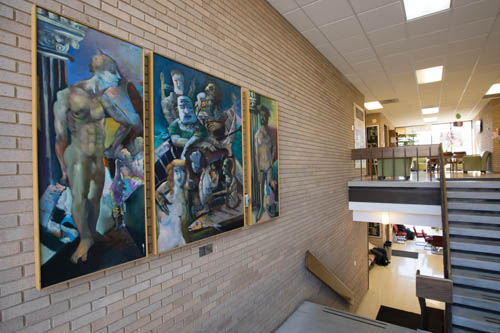
On the landing between the first and second floors of the Humanities-Social Sciences Building sits The Sacrosanct, 1978, a triptych by Edward Boccia, an American poet and painter known for his large-scale paintings in Neo-Expressionist style. It was donated by Morton D. May.

https://magazine.mst.edu/2018/03/art-on-campus/

Explore Our Pinterest Gallery

Join us on Pinterest for our favorite posts about art, art history, iconography, modernism, contemporary trends and of course, all about Edward Boccia!


Painting Pictured Above Edward E. Boccia Vivaldi


All Rights Reserved, The Edward E. Boccia and Madeleine J. Boccia Art Trust.

A Poem in memory of the artist by Alvin Horst….

Edward-Boccia, American-Art, American-Painting, Painting, American-Painters, Modern-Art, Contemporary Art, Ed-Boccia, St-Louis-Artist, WUSTL

September 13, 2012


Alvin Horst’s Poem

Contribute as the Cataloging Project Continues

The trust conducts an ongoing cataloging of the artist’s work and encourages all owners to share information about any Boccia work in their possession.

We are currently seeking information about the whereabouts of paintings and drawings by Edward Boccia, including the four paintings commissioned by the First National Bank in St. Louis in 1966, photographs or archival information is welcome.

Please contact us with any relevant information.