Katie White’s Artnet Article -Edward Boccia, the American Expressionist Who Time Forgot, Is Suddenly Everywhere

Edward Boccia, the American Expressionist Who Time Forgot, Is Suddenly Everywhere

Right now, an exhibition at New York’s Calandra Italian America Institute shines a a light on the under-recognized 20th-century painter.

Edward Boccia.

Edward Boccia (1921–2012) might be called America’s forgotten Expressionist.

In the mid-20th century, the New Jersey-born artist was a favorite of curators and influential collectors. His paintings fused the language of Expressionism, Surrealism, classical mythology, and Catholic iconography in rhapsodic, imaginative tableaux vibrating with color. Most prized were his triptychs, a format that harkened to the religious art of centuries past. For a time, he seemed poised for stardom. While in his late 20’s, Boccia was recruited to teach at Washington University in St. Louis, Missouri, alongside the likes of Max Beckmann and Philip Guston. Morton D. May, a famed American philanthropist and celebrated collector, alone owned more than 1,000 of his drawings and 100 paintings. Today, Boccia’s paintings and drawings remain in some 600 private and public collections in the U.S., Europe, and South America, including the St. Louis Museum of Art and the Denver Museum of Art.

Edward Boccia, Last Supper (1977). Collection of The Art Students League of New York

Edward Boccia, Last Supper (1977). Collection of The Art Students League of New York

But, even in curatorial circles, Boccia’s name is obscure—his fall into the footnotes of art history, remains a nuanced puzzle. Finally, a little over a decade after his death, the artist’s unique legacy may be coming back into focus.

Currently, New York’s Calandra Italian American Institute is presenting “Edward E. Boccia: Postwar American Expressionist,” an intimate exhibition of Boccia’s paintings, drawings, and journals made from 1958 to 1995 (the exhibition runs until February 21). This intriguing exhibition offers a window into a long, though under-recognized career, and an artist who infused modernist language with monumental philosophical and stylistic questions, and embraced rather than eschewed religious and spiritual themes.

“It’s a very intense experience when you’re looking at these images,” said Rosa Berland, honorary director of The Edward E. Boccia Artist Trust, who curated the exhibition. “Hybridity is key to many of these works. Hybrid creatures appear in so many of his pictures, and hybrid styles. It suggests, I think, the process and the awakening one finds in the creative process, but also revelation, through contemplating the nature of the soul.”

Berland first became aware of Boccia’s works when the St. Louis Museum hosted a posthumous retrospective of his work in 2013, for which she was asked to write a short essay. She soon recognized the complexity of his talents. Berland is not the only one to have woken the artist’s work and story. Argentine-American Eduardo Montes Bradley is currently working on “Looking for Edward Boccia” a documentary about Boccia’s life and legacy.

Edward Boccia Graduation Pratt Institute img569

Edward Boccia Graduation Pratt Institute.

Aspects of Boccia’s life are truly cinematic. Born in Newark, New Jersey, to Italian immigrants, Boccia was drawn to the creative life at a young age. A technically dexterous painter, Boccia studied at the Newark Arts High School, the Art Students League of New York, and Pratt Institute, where he met his wife, Madeleine Wysong, before being drafted into the army. During World War II, he served in the covert 603rd Camouflage Engineers, known as the Ghost Army, a top-secret unit that engaged in battlefield deceptions including inflatable tanks, sound effects, radio deceptions, and other creative imagination to disorient the German army (in March 2024, he was posthumously awarded the Congressional Gold Medal of Honor).

Later, Boccia returned to the Art Students League, enrolling at Columbia University where he would earn undergraduate and graduate degrees with the aid of the GI Bill. In 1948, in his mid-20s, he was hired as the dean of the Columbus Art School and moved to St. Louis, where he would make his home until the end of his life. In the city, which was experiencing a postwar contemporary art boom, Boccia immersed himself in the Group 15 of Saint Louis, an arts collective that included Werner Drewes, E. Oscar Thalinger, Belle Cramer, and Kenneth Hudson, among other significant artists from the region. Hudson, who worked at Washington University, would soon recruit Boccia to the university and an ambitious art department that included Max Beckmann and Philip Guston.

Edward Boccia, Bathers by the Sea—Homage to Max Beckmann (1995). Collection of The Art Students League of New York

Edward Boccia, Bathers by the Sea—Homage to Max Beckmann (1995). Collection of The Art Students League of New York

There, Boccia would fatefully meet the American philanthropist Morton D. May, who was the preeminent American collector of the works of Max Beckmann (his collection ultimately formed a pivotal gift to the St. Louis Museum of Art). May would become the primary patron and advocate for Boccia’s work (this siloed patronage, too, may have contributed to his later obscurity).

During the 1950s, Boccia drank in a rich array of influences from the St. Louis region including that of Thomas Hart Benton, whose vivid scenes of Midwestern industry and farming were imbued with drama and dynamism that captivated his attention. Max Beckmann’s work, however, proved the most pivotal influence on Boccia’s developing visual language (Boccia became deeply familiar with Beckmann’s work through visits to May’s unrivaled collection).

The German-born Beckman, who’d fled his home country for Paris and Amsterdam, after the notorious Degenerate Art exhibition of 1937, had chronicled the mores and debaucheries of Weimar cafe society with a keen perceptivity and had come to St. Louis, for several years, as he reoriented in the postwar world. Most notably, Boccia followed Beckmann’s embrace of the triptych ( Boccia would produce 46 large-scale triptychs and other multi-panel paintings including four large-scale polyptychs and six diptychs, throughout his career). Beckmann’s bustling, energetic multifigure compositions, with their expressive brushwork, too, shaped Boccia’s approach.

Edward Boccia, Self-Portrait (1958)

Edward Boccia, Self-Portrait (1958). Courtesy of the Edward E. Boccia Artist Trust, St. Louis.

Edward E. Boccia’s The Flesh Eaters (1996) a triptych that is the crowning work in the exhibition, evinces vestiges of Beckmann’s pictorial language, taking cues from the lively Paris Society (1925/1931/1947) as well as Beckmann’s Departure, Triptych (1932–1935). But also there’s an inscrutability to Boccia’s triptych. In the central canvas, a Deposition-like scene unfolds with a Christ figure, nude, hanging in the arms of an inscrutable figure behind him. On either side of the central panel are idiosyncratic, surrealist scenes of men and women smoking, a floating Buddha-esque figure, rainbows, and a box with feet inexplicably popping out of it. One figure, a noir-looking man in a fedora, reminded me of Edward Hopper’s self-portrait.

“What I would emphasize when it comes to Boccia is that when it comes to models and symbols and signs, everything is so layered and sort of syncretic,” explained Berland of this visual cacophony, “We look for precedents, but we have to understand that there’s almost a chemical combination, a disruptive way of putting recognizable symbols or styles or types in juxtapositions. Everything’s in contradiction, which creates contamination of symbols.”

Edward Boccia, The Flesh Eaters (1996). Courtesy of the Edward E. Boccia Artist Trust, St. Louis.

Edward Boccia, The Flesh Eaters (1996). Courtesy of the Edward E. Boccia Artist Trust, St. Louis.

While many of Boccia’s influences were his contemporaries, the artist also confidently reached back generations and even centuries. One of the earliest paintings in the show, Self-Portrait (1958) is a penetrative representation of the artist that takes cues from Albrecht Durer’s iconic self-portrait from 1500. The artist mimics Durer’s scandalizing hand gesture, one that is believed to hint at the generative gifts of God and the artist.

“Boccia is a very erudite artist. He makes references to classical music, to Greek mythology, to Jesus, Old and New Testament stories,” Berland added. “There’s autobiography in the painting and references to Renaissance and modern artists as well as Baroque and Mannerist artists.

Boccia, who traveled to Italy almost annually, was informed by the Renaissance masters and frequently drew from Catholic iconography rooted in his steadfast and near-mystical faith. His works, he said, explored “the lyricism which sings through every shaft of light and gesture from Venice to Sorrento (the ‘eye’ of Titian).”  In the painting, Dream of the Sea Myth (1958), a tempest of visions swirls together. The artist made the painting while in Rome. A view of rowboats in one corner of the painting recalls a moment standing on the San Angelo Bridge, which is lined with Bernini sculptures, and looking down toward the water. In another passage, the composition breaks open into abstract and geometric forms. A falling figure at the top of one panel seems to reference Tintoretto’s Miracle of the Slaves or his The Origin of the Milky Way (1575–1580)

Courtesy of the Edward E. Boccia Artist Trust, St. Louis.

Edward Boccia, Dream of the Sea Myth (1958). Courtesy of the Edward E. Boccia Artist Trust, St. Louis.

“He’s making a transition between figural painting and abstraction,” noted Berland, “He was very interested in the work of Cézanne. He talked about the building of shapes on canvas, and the process of seeing that we encounter in Cézanne’s work. Here we see some relationships Cézanne with his use of muted greens and blues.”

Religious themes are common and Boccia’s works were commissioned by Catholic and Jewish institutions in St. Louis in his lifetime, including murals for Brith Sholom Kneseth Israel Temple and at the Washington University Catholic Student Center Chapel.  His embrace of these overtly religious themes made Boccia hard to place in the narrative of Abstract Expressionism postwar America, another factor that made have contributed to his obscurity (Berland also believes a lingering anti-Italian sentiment may have sidelined his fame).

Eucharistic imagery, however, becomes an avenue for expressing complex personal tragedies. His surrealist Last Supper from 1977 and disfigured St. Jerome from 1989y, hint at the artist’s own understanding of sacrifice, bodily suffering, and rebirth.

Boccia in his studio, St. Louis, 1981.

“The artist was actually suffering from quite severe illness at this time. He had a kidney transplant. There are references to the body and pain and also to loss, including the loss of the artist’s own son,” she explained. “The way that he worked and understood the world is like an Italian Renaissance artist, in the sense that he was interested in technique and the depiction of sort of illusionism and realism, but was also very devout.”

For Berland, this exhibition, which came about through collaboration with the artist’s estate, run by his daughter, Alice, is a small introduction to a complex oeuvre. The selection of paintings offers a curiosity-piquing window into a much larger narrative. Berland, who will release a monograph on the artist’s works later this year, has been grappling with the slippery complexities of Boccia’s work for a decade and says she is still only at the beginning of her work.

“I would look at the paintings and the colors would be so intense, but I would also have the feeling of being engaged, intrigued, but sometimes very confused by the symbols,” she explained. “Particularly as an art historian, you look for precedents or canonical models. But his work is very disruptive layered and complicated. He always said that he was searching for a way to depict the mystery of life. There was something alchemical to his work.”

Rosa Berland will host a curator’s talk at the Calandra Italian American Institute on February 6, 2025. 

Katie White

Editor

Edward E. Boccia & Best of 2024 Italics: Television for the Italian American Experience

Curator’s Talk at the Calandra Institute on Feb 6th, 2025

Exhibition Opening on 10.29: Edward E. Boccia: Postwar American Expressionist

Boccia

Boccia

Edward E. Boccia: Postwar American Expressionist

EXHIBITION OPENING

Tuesday, October 29, 2024, 6pm

Curated by Rosa Berland

A selection of paintings, drawings, and never-before-seen journals by the artist Edward E. Boccia (1921–2012) is on view for the first time in New York City at the John D. Calandra Italian American Institute. Throughout his long yet under-recognized career, Boccia developed a new genre of contemporary monumental panel painting that functioned as devotional art while raising questions about ethical, philosophical, and stylistic problems in twentieth-century America. An imaginative and technically gifted artist greatly influenced by Max Beckmann and Philip Guston, Boccia produced work that expressed the crisis of morality experienced in the US in the face of war and consumerism. His bold paintings speak of desire, loss, and spirituality and provide a fresh perspective on what constitutes Italian American modernism. For more than thirty years, Boccia served as a professor of fine arts at Washington University, where he fostered generations of studio artists, thereby changing the landscape of American painting.

Exhibition curator Rosa Berland notes: “By reintroducing the visitor to Boccia’s experimental work, this exhibition seeks to create new dialogue around the diasporic practice of this important and accomplished Italian American artist.”

ON VIEW October 29, 2024–February 21, 2025

Gallery Hours: Monday–Friday, 9am–5pm

EXHIBITION OPENING October 29, 2024, 6pm

Free, open to the public, and held in person at the Calandra Institute.

RSVP by calling (212) 642-2094

Edward E. Boccia Ghost Army Artist, St Louis Today

Edward E. Boccia: Ghost Army artist

Hornthal Boccia 2

Charles “Phil” Hornthall, left, and Edward E. Boccia, sketching in a bombed-out church in Trevieres, France.

Edward E. Boccia served his country during World War II as a private in the 603rd Engineer Camouflage Battalion in the Ghost Army (23rd Headquarters Special Troops), which was presented a Congressional Gold Medal in March 2024. Born June 21, 1921, in Newark, New Jersey, to Cono and Frances Boccia, he was recruited by the U.S. Army while he was an art student at Pratt Institute in Brooklyn, New York, before enlisting on Aug. 15, 1942.

Boccia was one of many art school students recruited for this top-secret unit designed to deceive and mislead German forces. Prior to shipping out to Europe, the battalion disguised strategic military installations along the East Coast from the air using camouflage. The soldiers served as expert deceptive artists during several major campaigns in Europe by deploying inflatable decoys of U.S. military tanks, cannons and jeeps to create dummy airfields, artillery batteries and tank formations accompanied by sound effects.

The Ghost Army staged 20 battlefield deceptions from Normandy to the Rhine River. Starting in England in 1944, they traveled to France and Luxembourg and then to Germany in 1945. In September 1944, the Ghost Army staged the illusion of 20,000 U.S. troops during Gen. George Patton’s Operation Bettembourg along the Moselle River in France, securing an American victory.

Edward Boccia Fellow Soldiers Ghost Army poster.jpg
Sketches of fellow Ghost Army soldiers by Edward E. Boccia, 1944-45, Photo provided by the Edward E. Boccia Artist Trust

Like many other soldiers, Boccia would sketch in his free time behind enemy lines and in bombed-out cathedrals and send the drawings home to his mother. He drew numerous portraits of displaced Russian, French and Italian civilians along with his fellow soldiers in France, Germany and Luxembourg. Among his closest friends from Company B were Bill Blass and Arthur Shilstone. Blass became a world-renowned fashion designer and Shilstone worked as an illustrator for major magazines like Life and National Geographic.

Following the Allied victory in Europe, Boccia married Madeleine Wysong, a fellow student at Pratt Institute, on July 17, 1945. He earned bachelor’s and master’s degrees at Columbia University and began teaching and serving as dean at the Columbus (Ohio) Art School.

Boccia was the youngest art school dean in American history when the couple had their first child, David. Their second child, Alice, arrived after the family relocated to St. Louis in 1951, where Boccia served as professor in the School of Fine Arts of Washington University in St. Louis until 1985.

Boccia’s Studio Captured by Chris Scavatto: “The Painter’s Language” is a portrait of an artist by a student he inspired

Edward-Boccia, Chris-Scavotto, WUSTL, Art

The new exhibition from photographer Chris Scavotto opens at the Sheldon October 7.

BY

SEPTEMBER 23, 2022

2:22 PM

Boccia’s Legacy as a Teacher Lives on in University Exhibit at Missouri S&T

Edward Boccia was an American painter + professor of fine art at Washington University for over 30 years. his teaching legacy lives on symbolically in work on view at universities across the country.

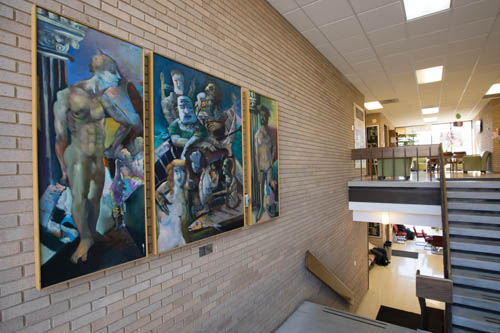
On the landing between the first and second floors of the Humanities-Social Sciences Building sits The Sacrosanct, 1978, a triptych by Edward Boccia, an American poet and painter known for his large-scale paintings in Neo-Expressionist style. It was donated by Morton D. May.

https://magazine.mst.edu/2018/03/art-on-campus/

Learning to see -Renaissance and Baroque Masterworks from the Phoebe Dent Weil + Mark S. Weil Collection at the St Louis Art Museum March 3-July 30 2017

Edward-Boccia, American-Art, American-Painting, Painting, American-Painters, Modern-Art, Contemporary Art, Ed-Boccia, St-Louis-Artist, WUSTL


An exhibition not to be missed –Learning to See: Renaissance and Baroque Masterworks from the Phoebe Dent Weil and Mark S. Weil Collection, St Louis Art Museum, March 3—July 30, 2017

From Rembrandt’s masterful Hundred Guilder Print to a colossal marble portrait of the Roman emperor Marcus Aurelius, Learning to See brings together prints, drawings, and sculptures that explore intellectual and spiritual currents of European culture in the 15th-17th centuries. Subjects included in the exhibition range from mythology and mythical beings to traditional Christian themes. Prints and sculptures are presented together, uniting seemingly dissimilar works across time and techniques while exploring a variety of themes. Devotional works of art demonstrate the vital role that prints and sculpture played in the early modern church. Other sections feature objects representing the body, both nude and clothed, and works that reveal the technical aspects involved in the sculpting of terracotta and bronze.

Dent Weil.jpg


Bust of Marcus Aurelius, late 18th–early 19th century; Italian; marble; with socle: 31 3/4 × 15 3/4 × 14 15/16 inches; Mark S. Weil Artwork 2011 Irrevocable Trust, Promised gift of Phoebe Dent Weil and Mark S. Weil


Read More @ SLAM 

Washington U. professor Edward Boccia left legacy of images -St Louis Post Dispatch


By Calvin Wilson, Post Dispatch February 16, 2013

Edward Boccia described his art as dealing with “love, lust and life,” and anyone who has stepped back and taken in his creations would be hard put to disagree. With a vividness that reflects the influence of artists from Max Beckmann to Paul Cézanne while adhering to a unique sensibility, Boccia’s paintings and drawings just about reach out and pull the viewer inside them.

For many years a professor at Washington University’s School of Fine Arts, Boccia died last September at his home in Webster Groves. Boccia was 91, and he had seen a lot, including action as a soldier in World War II. And he transformed quite a bit of what he saw into a legacy of countless images.

Boccia’s work, which attracted the backing of nationally renowned art collector Morton D. “Buster” May, is the subject of two exhibitions: “Edward Boccia: Figurative Expressionist,” through March 3 at the St. Louis University Museum of Art, and “Edward Boccia: Early Work,” opening Friday at the Sheldon Art Galleries.

edward-boccia-the-encounter-1979 Edward E. Boccia The Encounter, 1979

“He created his own world through his art,” said Petruta Lipan, director of SLUMA. “And his world is very complicated and multilayered.

“You look at his artworks, and you think you know what you’re looking at. But the more you look at it, the deeper and deeper it gets, because he mixes mythology and religion and literary themes within one work. And that’s what makes his work so interesting.”

Philanthropist May (of the May Department Stores, which owned the Famous-Barr chain) was an important figure in getting out the word about Boccia, said the artist’s daughter, Alice Boccia, who is an archeological conservationist.

“He was a huge art collector here in St. Louis, and every year he would come over to the house and look at all the work Dad had done for the past 12 months,” said Boccia, who now lives in Los Angeles. “From, say, 1952 until he passed away in 1983.”

May purchased hundreds of Boccia’s works, keeping them for his collection or giving them to museums, universities and acquaintances.

The exhibition at SLUMA focuses on Boccia’s large-scale paintings, including triptychs (three-panel paintings). The works are displayed with just enough room for spectators to stand back and ponder their meanings. Particularly striking are “Low Tide” (1983), which depicts a bearded man reading a book while impaled on what appear to be sticks rising out of the water, and “The Absolved” (1984), a portrait of a male and a female who have fish heads but human genitalia.

In contrast, “Edward Boccia: Early Work” is more intimate in scope. Olivia Lahs-Gonzales, director of the Sheldon Art Galleries, said the exhibition — which focuses on drawings and paintings made between 1941 and 1969 — sheds light on a different side of Boccia’s artistry.

“It gives people another view of what he was like as an artist, and his interests,” she said. Among the pieces are “drawings that he made during World War II, or right at the end of World War II, of fellow soldiers and people that he met in France and other places.

“You can see the influence of the Old Masters in his work,” Lahs-Gonzales said. “Also, people like Van Gogh.”

Boccia was born in Newark and studied art at Pratt Institute in New York (where he met his future wife, Madeleine Wysong). He is estimated to have created 4,000 paintings, and his work is included in more than 600 private collections, as well as being part of the permanent collections of SLUMA, the St. Louis Art Museum, Washington University’s Mildred Lane Kemper Art Museum, the Nelson-Atkins Museum of Art in Kansas City, the Denver Art Museum and the National Pinakothek in Athens.

It was through May that Boccia became familiar with the work of Beckmann, a German expressionist painter who taught at Washington University in the 1940s, and who had his first U.S. retrospective in St. Louis in 1948.But whereas Beckmann merely passed through St. Louis, Boccia – who came to Washington University in 1951 as an assistant dean – spent most of his life here.

“I can look at his work for years, and I still find something new,” Lipan said.


‘Edward Boccia: Early Work’

When • Friday through May 18. Opening reception is from 5 to 7 p.m. Friday; galleries open until 8 p.m. Regular hours are noon to 8 p.m. Tuesday, noon to 5 p.m. Wednesday-Friday, 10 a.m. to 2 p.m. Saturday and beginning an hour before performances and during intermission.

Where • Sheldon Art Galleries, Nancy Spirtas Kranzberg Gallery, 3648 Washington Boulevard

How much • Free

More info • 314-533-9900; thesheldon.org

‘Edward Boccia: Figurative Expressionist’

When • 11 a.m. to 4 p.m. Wednesday-Sunday; through March 3

Where • St. Louis University Museum of Art, Aronson Gallery, 3663 Lindell Boulevard

How much • Free

More info • 314-977-2666; slu.edu/sluma.xml


All Rights Reserved, The Edward E. Boccia and Madeleine J. Boccia Art Trust.

Rosalind Early’s 2011 Interview with the Late American Artist Edward E Boccia

Edward-Boccia, American-Art, American-Painting, Painting, American-Painters, Modern-Art, Contemporary Art, Ed-Boccia, St-Louis-Artist, WUSTL

Edward Boccia Remembered

By

In the magazine world, there are a lot of aborted articles. In 2011, on a rainy September afternoon, I went to artist and poet Edward Boccia’s house to interview him for an article that would never make it into St. Louis Magazine. Not sure what to do with the interview, I transcribed it and waited, since he’d told me SLU planned to do a retrospective in 2013. Unfortunately, Boccia died in September 2012. He was 91.

January 18, 2013


REPOSTED FROM THE ST LOUIS MAGAZINE -ARTICLE BY ROSALIND EARLY